
Why Do I Feel Emotionally Stuck? Ways Forward

You may be getting through your workday, caring for other people, and handling the practical parts of life, yet still find yourself asking, why do I feel emotionally stuck? Nothing may look dramatically wrong from the outside. But inside, you may feel disconnected, overwhelmed, numb, uncertain, or unable to make a decision you have been thinking about for months.
Feeling stuck is not a sign that you are lazy, broken, or incapable of change. Often, it is a sign that something in you needs attention, understanding, or support. Emotional stuckness can develop when your mind and body have been carrying more than they have had a chance to process.
Why Do I Feel Emotionally Stuck?
There is rarely one simple answer. People become emotionally stuck for different reasons, and those reasons often overlap. A difficult relationship, unresolved loss, ongoing stress, health concerns, family expectations, or a major life transition can all leave an emotional impact.
Sometimes the problem is not that you do not know what to do. You may know you need to set a boundary, have an honest conversation, make a change at work, or let go of something that is no longer healthy. The harder part may be the fear, grief, guilt, or uncertainty that comes with taking that step.
Emotional stuckness can also happen when you have spent a long time in survival mode. When daily life requires you to keep going, meet other people’s needs, and push through stress, there may be little room to notice what you are feeling. Eventually, the emotions that were set aside can show up as irritability, exhaustion, indecision, low motivation, or a sense that you are simply not yourself.
You May Be Protecting Yourself Without Realizing It
Emotions are not always comfortable, especially when they involve loss, disappointment, anger, shame, or fear. It makes sense that people try to avoid feelings that seem too painful or complicated. Avoidance can look obvious, such as staying constantly busy or withdrawing from others. It can also look more subtle, such as overthinking every decision, minimizing your needs, or telling yourself that your experience is “not a big deal.”
These responses can provide short-term relief. They may help you get through a difficult day or prevent a painful conversation. Over time, though, avoiding an emotion can keep it from moving through. The feeling does not disappear simply because it has not been named.
This is one reason people can feel stuck even after they have thought carefully about their situation. Insight matters, but insight alone does not always create emotional relief. You may understand why a relationship hurts and still feel unable to stop repeating the same pattern. You may know a loss changed you and still not know how to carry it forward.
Past Experiences Can Shape Present Reactions
A current situation may be pressing on an older emotional wound. For example, criticism from a partner or supervisor may feel especially painful if you learned early in life that approval was tied to being perfect. A disagreement may feel threatening if past relationships taught you that conflict leads to rejection. Difficulty asking for help may be connected to years of feeling that your needs were inconvenient or unsafe to express.
This does not mean you are trapped by your past. It means your reactions have a history. Understanding that history can replace self-judgment with compassion and give you more choices in the present.
It is also worth remembering that emotional patterns are not always dramatic. You do not need to have a single defining event in your past to benefit from exploring what you have learned about emotions, relationships, safety, and self-worth. Repeated smaller experiences can shape how you respond to stress just as powerfully.
Stuck Can Feel Like Numbness, Not Just Sadness
People often expect emotional difficulty to look like crying or obvious distress. In reality, feeling emotionally stuck can include numbness. You may struggle to identify what you feel, lose interest in things you usually enjoy, or feel detached from people you care about. You may be able to explain your life clearly without feeling connected to the emotions behind the story.
Numbness can be a protective response when emotions have felt too intense, too constant, or too unsafe to experience fully. It is not a personal failure. At the same time, it deserves care. Remaining disconnected for a long period can make it harder to recognize what you need and what would help you feel more like yourself.
Physical stress can play a role as well. Chronic illness, pain, disrupted sleep, hormonal changes, caregiving demands, and prolonged anxiety can affect mood, energy, and emotional capacity. Emotional health and physical health influence one another, so it can be helpful to consider both rather than assuming you should be able to think your way out of the problem.
Small Movement Is Still Movement
When you feel stuck, pressure to make a major change can make the problem feel larger. You do not have to solve your whole life at once. A more useful starting point is to become curious about the place where you feel stalled.
Ask yourself what has been hardest to admit, what feeling you tend to push away, or what decision you keep postponing. Notice whether you are waiting for certainty before acting. Many meaningful decisions do not come with complete certainty. They come with enough clarity to take one honest next step.
You might begin by writing down what you are feeling without trying to fix it. You could pay attention to when your mood shifts, what situations leave you drained, and what interactions make you feel smaller or more supported. Talking with one trusted person can help, provided that person can listen without rushing to judge or solve the problem.
These practices are not meant to replace professional care. They can, however, help you move from a vague sense of being trapped toward language for what is actually happening. Naming an experience is often the beginning of responding to it differently.
How Therapy Helps When You Feel Stuck
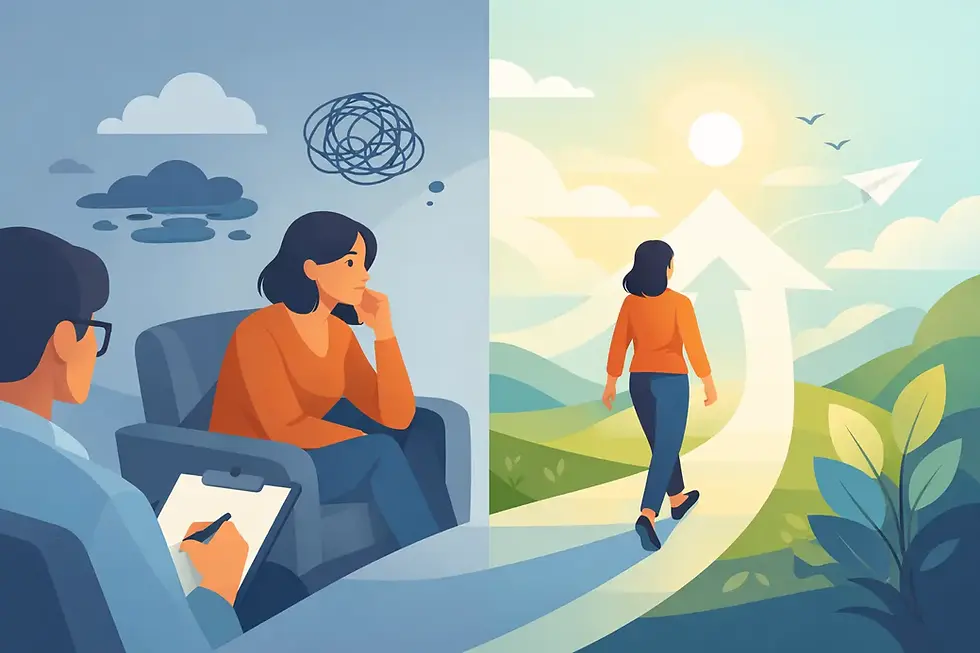
Therapy offers a private space to slow down and explore what is underneath the pattern. A neutral professional can help you notice connections that are difficult to see when you are living inside the stress every day. The goal is not for someone else to tell you what choices to make. The goal is to better understand your emotions, values, patterns, and options so you can make choices that fit your life.
In counseling, you may work through grief that has not had room to be felt, explore relationship dynamics, practice healthier boundaries, or learn to respond differently to self-critical thoughts. Therapy can be especially helpful when you have talked about an issue repeatedly but do not feel any closer to change. The therapeutic process creates space not only to discuss an experience, but to process its emotional weight.
For some people, an integrative approach may also feel helpful. Therapeutic Center for Change offers traditional psychotherapy along with Neuro Emotional Technique (NET), which may be considered as part of a broader, individualized approach to emotional and mind-body concerns. What is most useful depends on your goals, history, comfort level, and the type of support you need.
Progress is not always immediate or linear. You may have days when you feel clearer and days when old habits return. That does not mean therapy is failing. Change often involves practicing new responses while giving yourself patience when familiar patterns show up.
When to Reach Out Sooner
Feeling stuck can be painful on its own, but it is especially important to seek professional support when it begins affecting your ability to work, sleep, care for yourself, maintain relationships, or experience hope. Support is also warranted if you are using substances, isolation, anger, or other harmful behaviors to cope.
If you are having thoughts of harming yourself or someone else, seek immediate help through emergency services, a crisis service, or the nearest emergency department. You do not have to manage a safety concern alone.
You do not need to wait until life falls apart to ask for help. Sometimes the most courageous next step is simply admitting that what you have been carrying has become too heavy to carry by yourself. With support, the place that feels stuck can become a place where you begin to understand yourself more clearly and move forward with greater care.


Comments